
Introduction
Pieskowa Skała Castle stands as Poland’s finest preserved Renaissance residence, a white-walled architectural masterpiece perched atop limestone cliffs overlooking the Prądnik Valley within Ojców National Park. This elegant castle combines 14th-century defensive origins with sophisticated 16th-century Renaissance transformation, featuring a stunning arcaded courtyard that ranks among Poland’s most photographed architectural spaces. Moreover, Pieskowa Skała lies just 27 kilometers northwest of Kraków, making it one of the most accessible castles along the famous Eagles’ Nests Trail (Szlak Orlich Gniazd) that follows the Jurassic limestone highland from Kraków to Częstochowa.
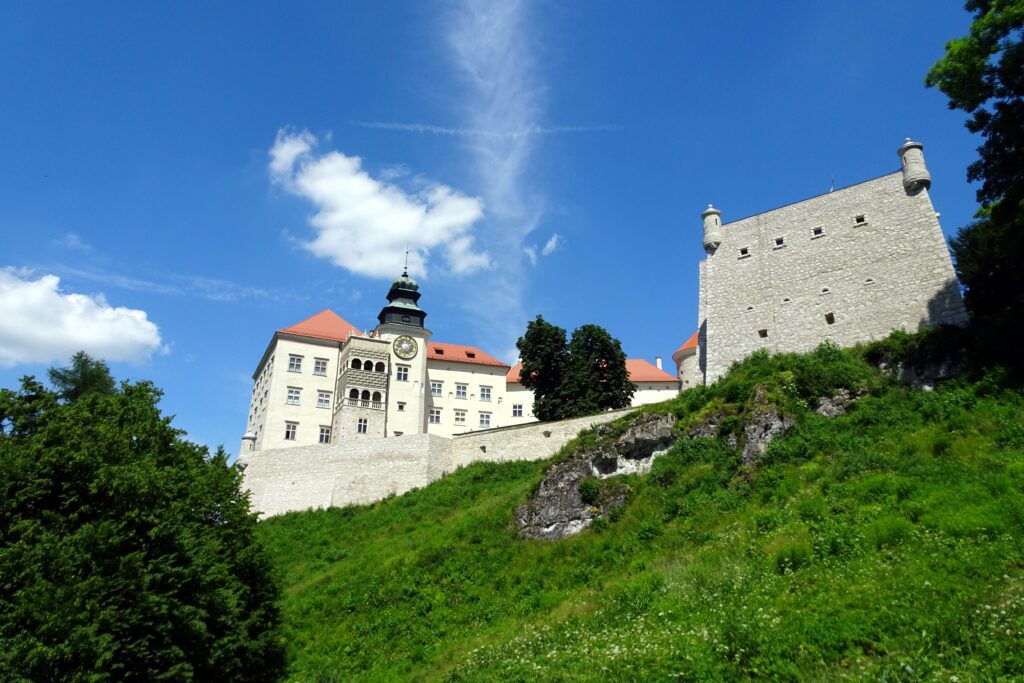
Pieskowa Skała appeals to architecture enthusiasts seeking intact Renaissance design elements rarely preserved elsewhere in Poland, as well as art lovers drawn to the castle’s role as a branch of Wawel Royal Castle Museum displaying European paintings and decorative arts. Additionally, families and hikers appreciate the castle’s position within Ojców National Park, where the distinctive Hercules Club limestone pillar creates one of Poland’s most iconic natural monuments standing just 400 meters from the castle walls. Furthermore, photographers capture the castle’s white walls and red roofs set against dramatic limestone formations, creating compositions that epitomize the romantic beauty of Poland’s Kraków-Częstochowa Upland.
This comprehensive guide explores Pieskowa Skała’s evolution from medieval fortress to Renaissance showpiece, details the castle’s remarkable arcaded courtyard and museum collections spanning European art and Polish manor interiors, explains how to reach the castle from Kraków using public buses or private transportation, and recommends hiking routes through Ojców National Park that combine castle visits with Poland’s most concentrated limestone landscape. Consequently, whether you visit for a two-hour museum tour or spend a full day exploring castle architecture and surrounding trails, this guide provides everything needed to experience the Renaissance jewel of the Polish Jura.
History of Pieskowa Skała: From Royal Fortress to Renaissance Palace
14th Century: Casimir the Great’s Border Defense
King Casimir III the Great (Kazimierz Wielki) established Pieskowa Skała Castle in the mid-14th century as part of a comprehensive border defense system protecting the Kingdom of Poland’s western frontier against Czech and Silesian incursions. The castle occupied a strategic position along the important trade route connecting Kraków with Upper Silesia, positioned atop limestone cliffs providing natural defensive advantages while controlling valley passages below. The original Gothic fortress followed typical medieval military architecture with thick stone walls, defensive towers, and minimal decorative elements prioritizing function over aesthetic considerations.
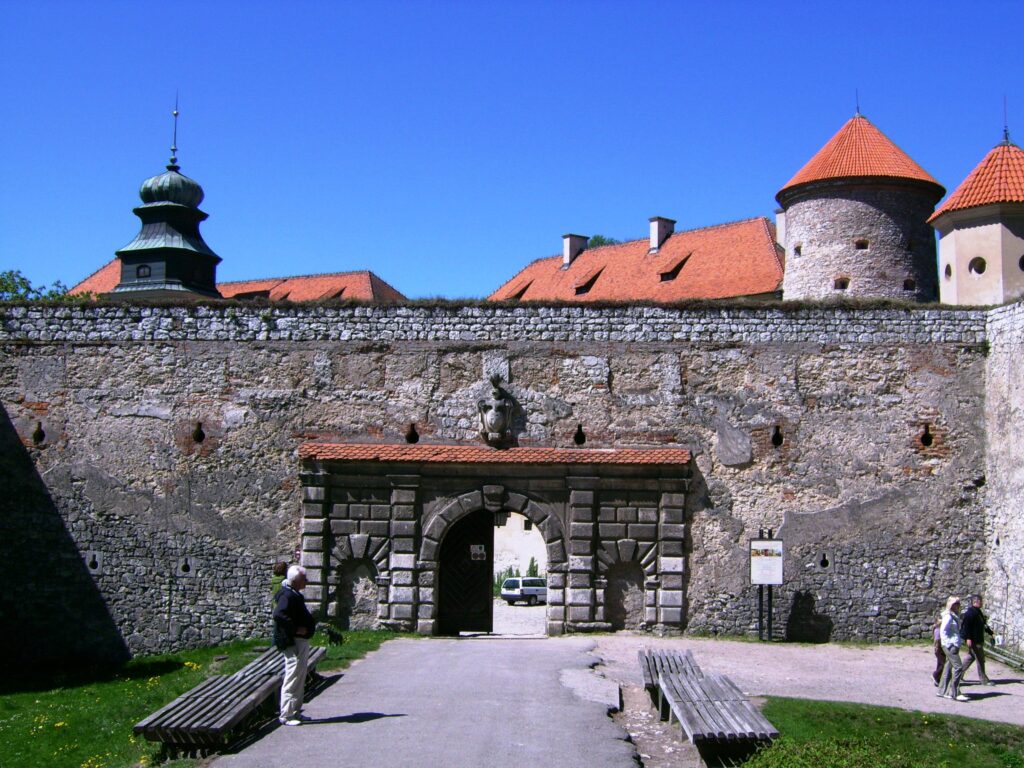
The castle name likely derives from “pies” (dog) combined with “skała” (rock), though scholars debate whether this references the defensive nature of a “watchdog” guarding trade routes or describes the distinctive limestone formations surrounding the site. Medieval documents first mention Pieskowa Skała in 1315, though King Casimir’s extensive construction occurred in the 1340s-1360s as part of his legendary castle-building campaign that created approximately 50 fortifications throughout Poland. This chain of strongholds, later known as the Eagles’ Nests Trail, transformed Poland’s western borderlands from vulnerable frontier into secure territory that enabled the kingdom’s subsequent expansion.
Renaissance Transformation Under the Szafrańcy Family
The most significant architectural transformation occurred between 1542-1580 when Hieronim Szafraniec, royal castellan and influential magnate, converted the Gothic military fortress into an elegant Renaissance residence reflecting the sophisticated Italian-influenced architectural tastes sweeping through Poland’s aristocracy. Szafraniec commissioned extensive renovations that retained the medieval fortifications while adding Renaissance palatial elements, most notably the spectacular three-story arcaded courtyard that became the castle’s architectural centerpiece. Italian and Polish master builders created harmonious classical arcades supported by stone columns, decorated with naturalistic masquerades (grotesque faces), heraldic cartouches displaying family coats of arms, and ornate portals featuring Renaissance decorative motifs.

The Renaissance reconstruction also added a distinctive viewing loggia providing panoramic vistas across the Prądnik Valley, formal Italian gardens with geometric layouts, decorative ponds stocked with fish, and menageries housing exotic animals that demonstrated the owner’s wealth and cultured sophistication. Contemporary accounts described Pieskowa Skała as one of the most elegant Renaissance residences in Lesser Poland, rivaling urban palaces in Kraków while offering pastoral mountain setting that aristocrats increasingly preferred for summer retreats. Moreover, the Szafrańcy embellished interiors with imported tapestries, Italian paintings, and furniture reflecting the cosmopolitan tastes of Poland’s Golden Age when the Polish-Lithuanian Commonwealth ranked as one of Europe’s most powerful states.
Swedish Wars and Subsequent Decline
The Swedish invasion during the mid-17th century wars known as “The Deluge” (Potop) brought catastrophic destruction to Pieskowa Skała along with hundreds of Polish castles, churches, and manor houses. Swedish troops captured the castle in 1655, systematically looting furnishings, artworks, and treasures before setting fires that damaged roofs and destroyed interior decorations. The castle suffered three major fires between the 17th and 19th centuries, each time losing additional Renaissance elements that made the Szafraniec-era residence so remarkable. Subsequent owners lacked resources to maintain the extensive complex, and by the 19th century Pieskowa Skała had deteriorated into partial ruin.
The 1880s brought Neo-Gothic additions when owners attempted modernization following contemporary architectural fashions, though these Victorian-era modifications compromised Renaissance authenticity that later conservation efforts sought to restore. By the early 20th century, the castle briefly functioned as a guesthouse and hosted natural history collections, though systematic restoration would not commence until after World War II when Polish authorities recognized Pieskowa Skała’s exceptional architectural and historical significance.
20th Century Restoration and Museum Creation
Comprehensive conservation works began in 1949 under the supervision of prominent Polish architects and conservators who aimed to restore Pieskowa Skała’s Renaissance appearance by removing inappropriate 19th-century additions and reconstructing damaged elements using period-appropriate techniques and materials. The decades-long restoration peeled back centuries of alterations, revealing original Renaissance architectural details including courtyard arcades, stone carvings, and structural elements that survived beneath later modifications. Additionally, conservators stabilized the castle’s foundations, repaired limestone walls damaged by water infiltration, and restored the distinctive red-tiled roof that crowns the white walls.

In 1970, Pieskowa Skała became a branch of the Wawel Royal Castle Museum, creating institutional connections that enabled transfer of art collections and furnished interiors from Kraków’s royal residence to the castle. Since original Renaissance furnishings had been lost during Swedish wars and subsequent fires, curators installed period furniture, paintings, and decorative arts from Wawel collections, creating museum exhibitions that illustrate Polish manor house culture and European artistic styles from the 16th-19th centuries. Today, Pieskowa Skała serves dual purposes as an architectural monument preserving Renaissance design and as a museum venue showcasing fine and decorative arts within authentic historical context.
What to See at Pieskowa Skała Castle: Architecture and Museum Collections
⭐ The Renaissance Arcaded Courtyard
Pieskowa Skała’s arcaded courtyard represents the architectural heart of the Renaissance castle, a perfectly proportioned three-story courtyard surrounded by classical arcades creating one of Poland’s most photographed Renaissance spaces. The arcades feature massive stone columns supporting rounded arches decorated with carved masquerades—grotesque faces combining human and animal features that served as both decorative elements and water spouts draining rainwater from upper galleries. Each level displays slightly different architectural treatments, with the ground floor featuring the most robust columns and the upper floors showing increasingly delicate proportions that create visual harmony and draw the eye upward toward the sky.

⭐ Visit the courtyard during mid-morning hours (10:00 AM-12:00 PM) when sunlight illuminates the arcades from optimal angles, creating dramatic shadows that emphasize the sculptural quality of columns, capitals, and carved decorations. The courtyard serves as the entrance to museum exhibitions and remains accessible to all castle visitors, providing exceptional photography opportunities even for those not purchasing exhibition tickets. Moreover, the courtyard’s intimate scale—approximately 24 by 27 meters—creates a sense of enclosure and human proportion rare in grand aristocratic residences, making Pieskowa Skała feel more like an elegant country villa than an imposing fortress.
⭐ Old Polish Manor Exhibition
The Old Polish Manor route (Trasa Zamek Staropolski) recreates the atmosphere of a 16th-18th century Polish noble residence through furnished period rooms displaying furniture, portraits, decorative arts, and household objects drawn from Wawel Royal Castle collections. Visitors progress through interconnected chambers including formal reception rooms featuring ornate Renaissance furniture, private chambers with canopied beds and personal belongings, and service areas showing how manor households functioned. The exhibition emphasizes authentic details including Oriental carpets covering tables rather than floors (following period customs), coffered ceilings with polychrome decorations, and tiled heating stoves characteristic of Polish noble interiors.
Museum highlights include the Portrait Gallery featuring 17th-18th century Polish nobility painted in characteristic Sarmatian style with elaborate costumes and symbolic attributes, and the Green Chamber displaying rare Renaissance furniture inlaid with exotic woods. Additionally, the route includes access to castle towers offering elevated views across Ojców National Park’s limestone landscape. Standard admission costs 18 PLN (regular) or 15 PLN (reduced), with the route requiring approximately 45-60 minutes for thorough exploration.
European Art and Style Exhibition
The extended route (Trasa Zamek Staropolski + Europejskie Style i Mody w Sztuce) adds galleries showcasing European painting, sculpture, and decorative arts spanning Gothic through 19th-century periods, illustrating artistic developments that influenced Polish culture through international connections. Exhibition sections organized chronologically demonstrate how Italian Renaissance, Dutch Baroque, French Rococo, and English Neoclassical styles reached Poland through aristocratic patronage and artistic exchanges. Paintings include religious works, portraiture, genre scenes, and landscapes by Polish and European masters, while decorative arts galleries display ceramics, glassware, textiles, and metalwork representing various regional traditions.

The English Interiors section recreates 18th-19th century salon atmosphere with paintings from English collections acquired by Polish aristocrats during Grand Tour travels, combined with period furniture, porcelain, and decorative objects that demonstrate Poland’s cultural connections with Western Europe. This extended route costs 28 PLN (regular) or 25 PLN (reduced) and requires 1.5-2 hours for complete exploration, making it suitable for visitors with serious interest in European art history and decorative arts traditions.
Special Weekend Route: From Cellars to Rooftop
On Saturdays and Sundays, the castle offers an enhanced route titled “Castle from Cellars to Rooftop” (Zamek od Piwnic po Dach) that includes areas normally closed to visitors. This special tour adds underground storage cellars with massive stone vaulting where castle households stored provisions, wine, and preserved foods, plus access to attic spaces beneath the distinctive red-tiled roof where visitors observe Renaissance timber construction techniques. The highlight involves climbing to rooftop terraces providing 360-degree panoramic views across Ojców National Park’s limestone plateau, the Prądnik Valley, and surrounding forested hills—perspectives impossible from ground-level viewpoints.
⭐ The rooftop access particularly appeals to photographers seeking dramatic elevated compositions showing the Hercules Club limestone pillar, valley landscapes, and the geometric patterns of Renaissance gardens. This weekend-only route requires advance booking due to limited group sizes (maximum 15-20 visitors per tour for safety reasons), costs 28 PLN, and includes guided commentary in Polish with limited English availability. Tours depart at scheduled intervals between 10:00 AM-4:00 PM, with last entry at 4:00 PM and tours lasting approximately 1.5 hours.
The Hercules Club Rock Formation
The Hercules Club (Maczuga Herkulesa) stands 25 meters tall as Poland’s most famous limestone pillar, positioned just 400 meters from Pieskowa Skała Castle along a well-maintained walking path requiring 10-15 minutes to reach. This distinctive rock formation narrows dramatically at its base where erosion has eaten away softer limestone layers, creating an inverted club shape that inspired the name referencing the mythological hero’s weapon. Geological processes that created the Hercules Club began 150 million years ago when this region formed the floor of a shallow tropical sea, with subsequent uplifting, erosion, and water chemistry producing the dramatic karst landscape characterizing Ojców National Park.
⭐ Multiple viewpoints surround the Hercules Club, with the most photographed perspective from the valley floor showing the pillar silhouetted against sky with forest background. Morning light (8:00-10:00 AM) provides the best photography conditions before the sun moves behind the rock face, though late afternoon golden hour (5:00-7:00 PM in summer) creates warm tones emphasizing the limestone’s cream-colored surface. Additionally, the area around Hercules Club includes benches and picnic areas where visitors rest while appreciating this natural monument, plus interpretive signs explaining the geological processes that sculpted the Jurassic limestone plateau.
Castle Gardens and Grounds
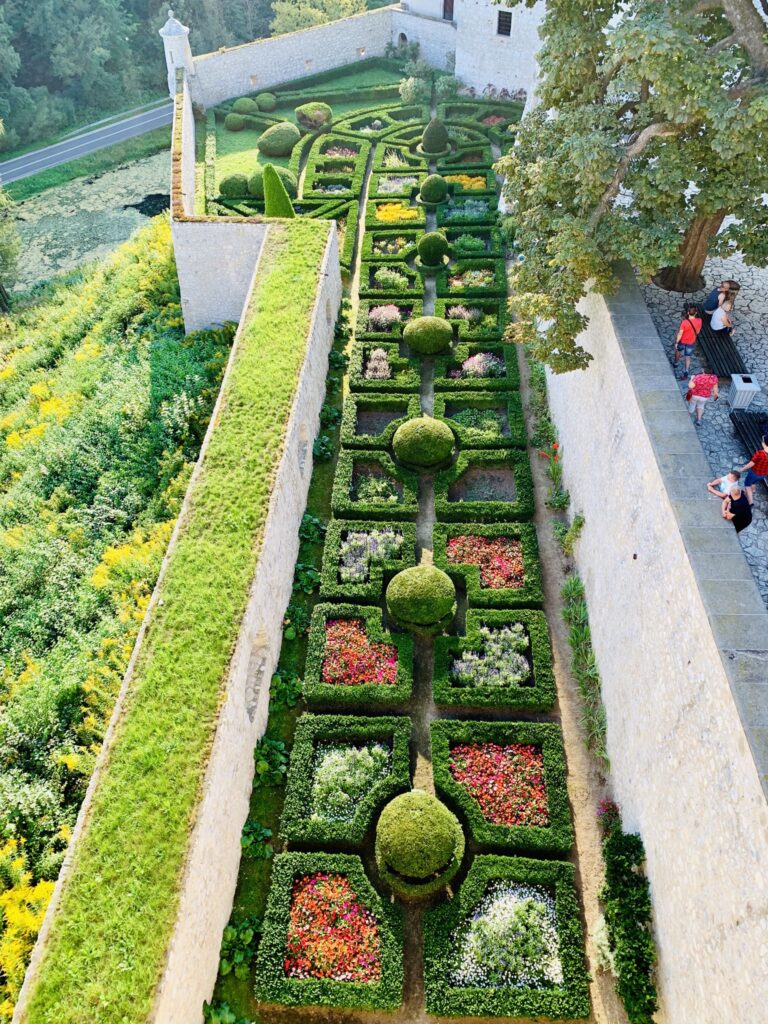
Renaissance formal gardens once surrounded Pieskowa Skała with geometric parterres, decorative fountains, and ornamental plantings that demonstrated aristocratic cultivation following Italian garden design principles. While the original gardens disappeared during centuries of neglect, recent landscape restoration has recreated simplified geometric layouts using period-appropriate plantings including boxwood hedges, roses, and herbs typical of Renaissance aristocratic gardens. The gardens provide pleasant walking areas with benches offering castle views, plus seasonal displays of spring bulbs, summer perennials, and autumn foliage that create colorful photographic foregrounds for castle compositions.
How to Reach Pieskowa Skała: Transportation from Kraków
Public Bus from Kraków (36-48 minutes)
Koleje Małopolskie operates direct bus route A13 from Kraków to Pieskowa Skała, providing the most economical transportation option for independent travelers. Buses depart from two Kraków locations: Kraków Piaszczysta (a suburban station) and the main Kraków MDA Bus Station (Dworzec Autobusowy). The Piaszczysta departure offers slightly faster journey times (36 minutes) compared to the central bus station route (47 minutes), though the main station proves more convenient for travelers staying in Kraków’s Old Town or arriving at Kraków Główny railway station.
Services operate approximately 4 times daily, though schedules vary by day and season, requiring advance consultation of the Koleje Małopolskie website (kolejemalopolskie.pl/en) or mobile app to confirm exact departure times. Tickets cost 6-8 PLN purchased directly from drivers (cash only) or through the mobile app (card payment accepted). Buses stop at “Sułoszowa Pieskowa Skała” directly at the castle parking area, requiring only 5 minutes walking to reach the castle entrance. ⭐ Take morning departures around 8:00-9:00 AM to maximize time at the castle and Ojców National Park, allowing full-day exploration before catching afternoon return buses departing around 3:00-5:00 PM.
Driving from Kraków (38 minutes)
Rental car provides maximum flexibility for exploring Pieskowa Skała combined with nearby Ojców National Park attractions including caves, hiking trails, and the village of Ojców itself. The 32-kilometer route follows road 794 northwest from Kraków through the suburban town of Skała, then continues along well-maintained regional roads passing through the Prądnik Valley’s scenic limestone landscape. Journey time runs approximately 38 minutes under normal conditions, though summer weekend traffic can add 15-20 minutes when domestic tourists flood the national park.
Free parking exists in designated lots immediately adjacent to the castle, accommodating approximately 100-150 vehicles though spaces fill completely on sunny summer weekends (June-August) and holidays. ⭐ Arrive before 10:00 AM during peak season to secure convenient parking; afternoon arrivals may require parking 10-15 minutes walking distance. Additionally, driving enables visiting multiple attractions in a single day including the cave complexes at Łokietek’s Cave and Dark Cave, the Chapel on the Water at Ojców village, and other Eagles’ Nests castles along the Jurassic highland north of Pieskowa Skała.
Organized Tours from Kraków
Numerous Kraków-based tour operators offer half-day and full-day excursions to Pieskowa Skała combined with Ojców National Park hiking, priced typically 150-250 PLN per person including transportation, English-speaking guide, and sometimes packed lunches. These tours generally operate as small group experiences (8-15 people) in comfortable minibuses, departing from central Kraków locations around 9:00-10:00 AM and returning around 3:00-5:00 PM. Tour packages usually include 1.5-2 hours at Pieskowa Skała followed by guided walks through Ojców National Park to see the Hercules Club, Łokietek’s Cave, and other geological attractions.
Organized tours eliminate navigation concerns and parking challenges while providing cultural and historical commentary from knowledgeable guides, though they offer less flexibility than independent travel regarding time allocation at specific attractions. Moreover, tours typically include only basic castle admission rather than extended museum routes, potentially disappointing visitors interested in detailed art exhibitions. Nevertheless, tours suit visitors without cars, those uncomfortable driving in Poland, and travelers preferring structured itineraries over independent exploration.
Taxi and Ride-Share Services
Taxis from central Kraków to Pieskowa Skała cost approximately 90-110 PLN one-way, making round-trip taxi transportation (180-220 PLN) economically competitive with organized tours when traveling as couples or small groups. Ride-sharing services including Uber and Bolt operate in Kraków and serve destinations throughout the region, typically offering 10-20% savings compared to traditional taxis. However, return trips require pre-arranging taxi pickup times or accepting potential wait times (20-40 minutes) for ride-share vehicles to reach the relatively remote castle location.
Best Time to Visit Pieskowa Skała: Seasonal and Daily Timing
Museum Opening Hours and Ticket Information
Pieskowa Skała Castle operates on variable schedules depending on season and day of week. During standard season, exhibitions close Mondays (though the exterior courtyard remains accessible free 9:00 AM-4:00 PM), open Tuesdays with free admission to selected exhibitions, and maintain regular hours Wednesday-Sunday. Spring-autumn typical hours run Wednesday-Friday 9:30 AM-4:00 PM (last entry 3:30 PM), with extended weekend hours Saturday-Sunday 9:30 AM-5:00 PM (last entry 4:30 PM on weekends). Winter schedules often reduce by one hour.
⭐ Purchase tickets online through the official website (pieskowaskala.eu) or at the castle ticket office, though online booking guarantees admission during busy periods when walk-up tickets may sell out. Ticket prices for 2026: Old Polish Manor route 18 PLN regular/15 PLN reduced; Extended route including European art 28 PLN regular/25 PLN reduced; Weekend special “Cellars to Rooftop” tour 28 PLN. Family tickets and group discounts available for parties of 10+ persons with advance booking. Allow 1.5-2 hours minimum for museum visits, or 3-4 hours when combining castle tours with Hercules Club walk and castle grounds exploration.
Spring (April-May)
Spring brings pleasant temperatures ideal for combined castle and hiking itineraries, with daytime highs typically 15-20°C (59-68°F) and blooming wildflowers carpeting Ojców National Park’s meadows and forest floors. The castle gardens display spring bulbs including tulips and daffodils, creating colorful foregrounds for castle photography. However, April remains unpredictable with occasional rain requiring waterproof layers and sturdy footwear. Moreover, spring weekends attract significant domestic tourism as Polish families take advantage of good weather for countryside excursions, meaning moderate crowds at the castle though not approaching summer peak levels.
Summer (June-August)
Summer delivers peak tourist numbers to Pieskowa Skała, with daily crowds including organized tour groups, families on school vacations, and international visitors. The castle and Ojców National Park appear at their most photogenic with brilliant sunshine, lush vegetation, and warm temperatures (20-30°C / 68-86°F) suitable for extended outdoor exploration. Nevertheless, summer also means largest crowds, advance ticket booking requirements, parking challenges, and hot midday conditions that make afternoon castle interior visits more appealing than hiking. ⭐ Summer visitors should arrive before 10:00 AM to beat tour bus crowds, complete castle touring by early afternoon, then spend later afternoon hiking shaded forest trails that remain pleasantly cool even during heat waves.
Autumn (September-October)
⭐ Autumn represents the optimal season for Pieskowa Skała visits, combining ideal temperatures (15-20°C / 59-68°F), dramatically reduced crowds compared to summer, and spectacular foliage as limestone forests transform into golden-orange tapestries visible from castle towers and valley viewpoints. September maintains warm sunny weather perfect for both museum touring and hiking, while October brings cooler conditions and autumn colors that create painterly landscapes throughout Ojców National Park. Additionally, September weekends occasionally feature Renaissance festivals and historical reenactments at the castle, adding cultural performances to standard museum offerings.
Winter (November-March)
Winter transforms Pieskowa Skała into a snow-dusted fairy tale castle, though harsh weather and reduced museum hours make visits challenging compared to warmer seasons. The castle maintains limited winter schedules (check website for specific dates), often closing completely during January-February or opening only weekends. Nevertheless, hardy winter visitors encounter nearly empty castle halls and snow-covered landscapes creating magical atmosphere particularly appealing to photographers willing to brave sub-zero temperatures. Winter hiking through Ojców National Park requires proper cold-weather gear and awareness that some trails become icy and potentially dangerous without appropriate footwear.
Where to Eat Near Pieskowa Skała: Dining Options
Herbova Restauracja & Kawiarnia (at the Castle)
Herbova Restauracja & Kawiarnia operates within the castle complex just 100 meters from the main entrance, providing convenient on-site dining featuring Polish traditional cuisine and international menu options. The restaurant serves hearty portions including żurek (sour rye soup) in bread bowls (16 PLN), various pierogi preparations with potato, cheese, meat, or fruit fillings (18-24 PLN for generous portions), and breaded pork schnitzel with potatoes and salad (32 PLN). Additionally, the menu includes lighter options such as sandwiches, salads, and cakes suitable for quick lunches between castle touring and hiking.
The welcoming interior features rustic Polish country décor with wooden furniture and regional decorative elements, while summer outdoor seating provides views toward castle walls and surrounding limestone landscape. Service proves reasonably quick even during busy lunch periods (12:00-2:00 PM), making Herbova practical for visitors on tight schedules. Prices remain moderate by Polish standards, with complete meals including soup, main course, and beverage costing 40-60 PLN per person. Moreover, the attached café serves excellent coffee, homemade cakes, and ice cream—perfect for post-hike refreshments.
Restauracja i Pizzeria Bocianówka (Ojców Village, 3.5 km)
Located in Ojców village approximately 3.5 kilometers from Pieskowa Skała, Restauracja i Pizzeria Bocianówka combines traditional Polish cooking with Italian-style pizzas, creating diverse menu suitable for families and groups with varying tastes. The Polish section emphasizes home-style comfort food including rosół (chicken soup with noodles, 12 PLN), hearty meat dishes, and seasonal specialties, while the pizza menu offers creative toppings on thin-crust bases (28-42 PLN for medium pizzas serving 1-2 people). Reviews consistently praise friendly service, generous portions, and reasonable prices that undercut tourist-focused restaurants in nearby Kraków.
The restaurant occupies a traditional building with rustic interior and garden seating during warm weather, creating relaxed atmosphere appreciated by hiking groups and families after exploring national park trails. Moreover, Bocianówka’s Ojców village location makes it ideal for visitors combining Pieskowa Skała with visits to Ojców’s Chapel on the Water, Łokietek’s Cave, or hiking circuits that pass through the village. Nevertheless, reaching Bocianówka from Pieskowa Skała requires either driving (8 minutes) or hiking along marked trails (45-60 minutes walking through scenic valley).
Kawiarnia Niezapominajka (Ojców Village)
This small café in Ojców village specializes in homemade cakes, coffee, and light meals including sandwiches, soups, and salads suitable for hikers seeking refreshments without heavy restaurant meals. The intimate interior accommodates perhaps 15-20 guests, creating cozy atmosphere particularly appealing during cool weather when hot tea and fresh-baked pastries provide perfect trail breaks. Prices remain remarkably affordable with cakes around 8-12 PLN per slice and coffee 8-10 PLN, making Niezapominajka excellent value for budget-conscious travelers.
Alternative: Packed Lunches and Picnicking
Many visitors to Pieskowa Skała and Ojców National Park prefer bringing packed lunches from Kraków supermarkets or bakeries, taking advantage of numerous picnic areas with benches scattered throughout the park near the Hercules Club, along valley trails, and at scenic viewpoints. This approach saves money, avoids restaurant crowding during peak lunch hours (12:00-2:00 PM), and provides flexibility to eat whenever hunger strikes during hiking. Moreover, several small shops in Ojców village sell drinks, snacks, and basic provisions for visitors who need supplementary items or forgot essential picnic components.
Where to Stay Near Pieskowa Skała: Accommodation Options
Guesthouses in Ojców National Park
Several family-run guesthouses (agroturystyka and pokoje gościnne) operate within Ojców village and surrounding national park areas, offering simple but comfortable rooms in peaceful settings surrounded by limestone landscapes. These accommodations typically feature private bathrooms, regional breakfast options, and hosts who provide insider knowledge about hiking trails and local attractions. Prices range from 40-80 PLN per person per night, representing exceptional value for travelers prioritizing nature immersion and early-morning trail access over urban amenities.
Advantages of staying within the national park include immediate access to hiking trails without morning commutes, quiet evenings surrounded by nature, and opportunities to experience the park during dawn and dusk when lighting creates magical conditions and day-trip crowds have departed. Nevertheless, evening dining options remain very limited within the park, requiring self-catering capabilities or driving to nearby towns for restaurant meals. Additionally, room availability is limited with perhaps 100-200 total beds across all park accommodations, necessitating advance booking particularly during summer peak season and autumn weekends.
Kraków as Base City (27 km)
Most visitors to Pieskowa Skała base themselves in Kraków, taking advantage of Poland’s cultural capital’s vast accommodation options spanning budget hostels (from 60 PLN per bed in dormitory), mid-range hotels (250-400 PLN for double rooms), and luxury properties (500+ PLN). Kraków provides infinitely greater dining, entertainment, and shopping diversity compared to rural national park accommodations, making it practical for travelers spending several days exploring Małopolska region while taking day trips to Pieskowa Skała, Wieliczka Salt Mine, Auschwitz-Birkenau, and other attractions within 50-100 kilometer radius.
The 27-kilometer distance means early departures (8:00-9:00 AM) enable full-day explorations with comfortable evening returns to Kraków accommodations. Moreover, Kraków’s Old Town, Kazimierz Jewish Quarter, and Wawel Castle provide world-class urban sightseeing that balances countryside castle visits, creating comprehensive travel experiences showcasing both Poland’s cultural heritage and natural beauty. Additionally, Kraków’s position as a major transportation hub means easy access via international flights, trains throughout Europe, and long-distance buses, whereas Ojców National Park lacks any direct public transportation connections requiring transfers through Kraków.
Skała Town (8 km)
The small town of Skała positioned 8 kilometers east of Pieskowa Skała offers limited accommodation options including small hotels and private rooms, creating a compromise between Ojców’s rural character and Kraków’s urban convenience. Skała provides basic services including restaurants, grocery shops, and banks, making it more self-sufficient than tiny Ojców village while maintaining quiet small-town atmosphere. However, accommodation quality and availability remain limited compared to Kraków, and most travelers find that either committing to remote national park guesthouses or basing in Kraków provides better overall experiences than the middle-ground Skała option.
What to See Near Pieskowa Skała: Ojców National Park Attractions
⭐ Łokietek’s Cave and Dark Cave
Ojców National Park contains over 400 caves carved through Jurassic limestone by underground water flows over millions of years, with Łokietek’s Cave (Jaskinia Łokietka) and Dark Cave (Jaskinia Ciemna) offering the most accessible public tours. Łokietek’s Cave stretches 320 meters with chambers featuring impressive stalactite and stalagmite formations illuminated by electric lighting, plus the legendary connection to King Władysław Łokietek who allegedly hid in the cave during 14th-century political conflicts. Guided tours (required for cave access) depart regularly throughout the day during spring-autumn season, lasting approximately 30 minutes and costing around 12-15 PLN per person.
Dark Cave provides more challenging exploration including sections requiring stooping and careful footing through narrow passages, appealing to adventurous visitors seeking experiences beyond standard tourist caves. Both caves maintain constant cool temperatures (8-10°C / 46-50°F year-round), requiring warm layers even during summer visits. Cave locations within 2-3 kilometers of Pieskowa Skała make combined castle-cave itineraries practical for full-day explorations.
Chapel on the Water (Ojców Village)
The Chapel on the Water (Kaplica na Wodzie) stands as one of Poland’s most photographed small churches, a wooden Neo-Gothic structure built in 1901 positioned on an artificial island within a small pond created by damming the Prądnik stream. The chapel’s distinctive reflection in still water creates mirror-image compositions beloved by photographers, particularly during morning hours when calm conditions and soft light emphasize the romantic atmosphere. The chapel remains an active Catholic worship site while welcoming respectful visitors throughout the day, positioned in central Ojców village approximately 3.5 kilometers from Pieskowa Skała.
Kraków Gate Rock Formation
The Kraków Gate (Brama Krakowska) consists of two massive limestone towers flanking the Prądnik Valley, creating a natural gateway marking the southern entrance to Ojców National Park. This dramatic geological formation rises approximately 20-25 meters, with weathered limestone surfaces displaying the distinctive karst erosion patterns that characterize the entire Jurassic highland. Well-marked hiking trails pass through the Kraków Gate, with interpretive signs explaining the geological processes that created these imposing rock towers and the broader valley landscape.
Eagles’ Nests Trail Castles
Pieskowa Skała represents just one castle along the Eagles’ Nests Trail (Szlak Orlich Gniazd), a historic defensive chain stretching 164 kilometers from Kraków to Częstochowa through the Kraków-Częstochowa Upland. Nearby castles accessible for day trips include the ruins at Ojców (dramatic clifftop remains 3 kilometers away), Rabsztyn Castle (20 kilometers north), Ogrodzieniec Castle (45 kilometers north, the most spectacular ruins along the entire trail), and Będzin Castle (60 kilometers north). These medieval fortresses occupy similarly dramatic limestone cliff positions, creating exceptional photography opportunities and historical insights into Poland’s medieval border defense systems.
Hiking Trails Through Ojców Valley
Ojców National Park maintains approximately 17 kilometers of well-marked hiking trails ranging from easy valley-floor paths suitable for families to moderately challenging routes climbing limestone cliffs for panoramic viewpoints. The most popular circuit combines Pieskowa Skała, Hercules Club, Łokietek’s Cave, Chapel on the Water, and Ojców Castle ruins in a 6-8 kilometer loop requiring 3-4 hours including stops for photography and rest breaks. Trails follow predominantly forested routes providing shade during summer heat, passing numerous smaller rock formations, seasonal waterfalls, and viewpoints overlooking the Prądnik Valley’s dramatic limestone landscape.
Practical Tips for Visiting Pieskowa Skała
What to Bring
Comfortable walking shoes with good traction prove essential for exploring Pieskowa Skała’s castle and surrounding national park, as paths include uneven stone surfaces, steps, and potential mud after rain. Additionally, layered clothing accommodates castle interior temperatures (cooler than outside particularly in stone corridors and towers) and variable weather conditions. Bring water bottles and snacks particularly when combining castle visits with hiking, as restaurant options remain limited within the national park and heat/exertion increase hydration needs during warm weather.
⭐ Camera equipment including wide-angle lenses captures the Renaissance courtyard’s architectural details and surrounding limestone landscapes effectively, while polarizing filters reduce glare from white castle walls and enhance sky contrast. Moreover, bringing cash ensures smooth transactions for castle admission, parking fees, and restaurant meals, though the castle ticket office accepts credit cards for museum tickets. Sunscreen and sunglasses become necessary during summer visits when reflected light from limestone and white castle walls intensifies UV exposure.
Photography Guidelines
Photography for personal use is permitted throughout Pieskowa Skała Castle including the courtyard and museum exhibitions, though flash photography and tripods require special permission protecting sensitive artworks and other visitors’ experiences. ⭐ The arcaded courtyard provides the castle’s most photographed space, with morning hours (9:00-11:00 AM) offering optimal light conditions when sun illuminates the arcades from favorable angles. Additionally, elevated views from castle towers (included in extended museum routes) enable architectural photography showing the castle’s complete layout, roof patterns, and relationship to surrounding limestone landscape.
The Hercules Club limestone pillar permits photography from all angles and times of day, though morning light (8:00-10:00 AM) generally creates the most dramatic compositions before sun position creates harsh shadows or backlit conditions. Respect other visitors by not monopolizing viewpoints during busy periods, and avoid disturbing wildlife or trampling sensitive vegetation when seeking creative shooting angles.
Accessibility Considerations
Pieskowa Skała’s Renaissance architecture presents significant accessibility challenges for visitors with mobility limitations, as the castle features multiple staircases, uneven stone floors, narrow doorways, and limited elevator access. The ground-floor courtyard remains fully accessible and provides the castle’s architectural highlight, though museum exhibitions on upper floors require climbing stairs. The castle staff accommodates wheelchair users with advance notice (phone +48 12 389 60 04), arranging alternative routing when possible and providing detailed accessibility information for specific museum routes.
The walking path to Hercules Club (400 meters from castle parking) maintains reasonably good surface conditions suitable for wheelchairs during dry weather, though some sections include gentle slopes and potential rough patches requiring assistance. Nevertheless, most Ojców National Park hiking trails feature uneven terrain, rocky sections, and stairways that prove difficult or impossible for wheelchair access, limiting mobility-impaired visitors primarily to castle courtyard, Hercules Club, and roadside viewpoints.
Combining Attractions for Efficient Itineraries
⭐ The most efficient full-day itinerary combines Pieskowa Skała castle tour (1.5-2 hours) with the short walk to Hercules Club (30 minutes round-trip including viewing time), followed by driving or hiking to Ojców village (3.5 kilometers / 45-60 minute walk) for lunch and afternoon exploration of Łokietek’s Cave, Chapel on the Water, and Ojców Castle ruins. This schedule provides comprehensive introduction to both Renaissance architecture and Ojców National Park’s geological attractions, requiring either rental car for flexibility or strong hiking ability to connect sites using marked trails.
Alternatively, castle-focused visitors can dedicate 2-3 hours to thorough museum exploration including the weekend “Cellars to Rooftop” special route, then spend afternoon relaxing at castle grounds and Hercules Club area without attempting full national park circuits. This relaxed approach suits travelers less interested in extensive hiking or those visiting during hot summer weather when lengthy trail walking becomes uncomfortable.
Seasonal Events and Special Programs
⭐ Pieskowa Skała occasionally hosts Renaissance festivals, historical reenactments, classical music concerts, and art exhibitions beyond permanent museum collections. These special events typically occur during summer weekends (June-August) and around major holidays, adding cultural performances and themed programming to standard museum offerings. Check the official website (pieskowaskala.eu) for current event calendars, as these programs provide enhanced experiences showcasing castle architecture as living cultural venue rather than static historical monument. Nevertheless, special events bring larger crowds and may require advance ticket booking to guarantee admission.