Introduction
Błędów Desert Poland, often called the “Polish Sahara”, is the largest inland area of loose sand in Central Europe, covering around 33 km². Although parts of the area are now overgrown with grass and shrubs, the main viewpoints still overlook a wide belt of golden sand that looks like a real desert dropped into the middle of Silesian forests. Moreover, Błędów Desert Poland lies roughly halfway between Kraków and Katowice, making it a perfect half-day trip by car from either city.
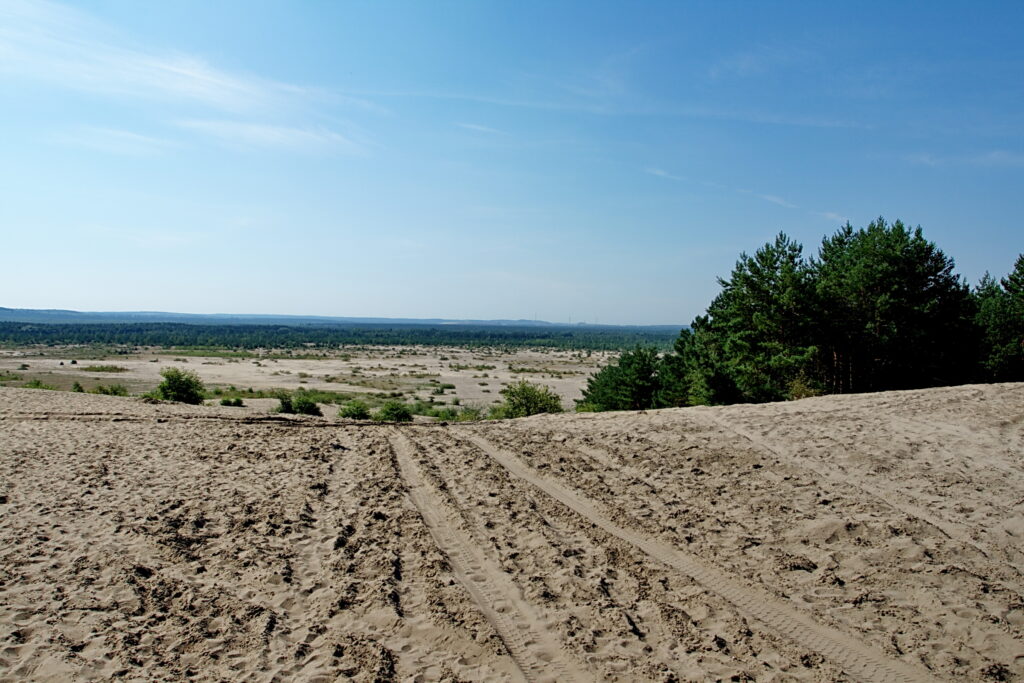
Błędów Desert Poland attracts landscape lovers, photographers searching for strong contrast between sand and forest, and visitors interested in geology and the impact of human activity on the environment. Additional attractions include developed viewpoints – including the modern wooden “Rose of the Winds” platform – hiking and cycling paths, and zones used by the army where you can sometimes observe parachute jumps from a safe distance. Families with children appreciate the easy access to viewpoints, benches and shelters, and the chance to play safely on the sand in designated areas.
This guide explains how Błędów Desert formed, the local legend about a devil spilling sand from the Baltic Sea, and why the sand layer reaches 40–70 meters deep in places. Additionally, you will discover the three best viewpoints, recommended walking routes, how to get there from Kraków and Katowice, and practical tips about safety, accessibility, and the best time of day for photography. Furthermore, you will find ideas on how to combine the desert with castles and rock formations of the Kraków-Częstochowa Upland.
History and Formation of Błędów Desert Poland
Natural origin – post-glacial sands
Błędów Desert was shaped by post-glacial processes. Thousands of years ago, a retreating ice sheet left behind huge quantities of sand washed out by meltwater rivers. As a result, on the border of the Silesian Upland and Olkusz Upland, a thick layer of loose deposits formed, averaging around 40 meters thick and reaching up to 70 meters in some places. For centuries these sands were largely stabilized and covered by forest.
Only in the 19th century did intensive human activity expose the sand again. Massive deforestation to feed local mining and smelting industries around Olkusz and Dąbrowa Górnicza lowered the groundwater level and removed vegetation, triggering renewed dune-forming processes. Wind began to shape ripples and dunes, creating a true desert-like landscape on a scale not seen anywhere else in Poland.
Legend of the devil and the Olkusz mine
A popular folk legend explains the desert’s origin in more dramatic fashion. According to the story, the devil wanted to bury the rich silver mine in Olkusz under sand to stop the miners. He filled a huge sack with sand from the Baltic coast and flew south, but caught his bag on a church tower near Klucze. The sack tore and the sand spilled out over a vast area – creating Błędów Desert. Science tells a different story, yet the legend adds a fairy-tale flavour to the place.
Military training ground and landscape changes
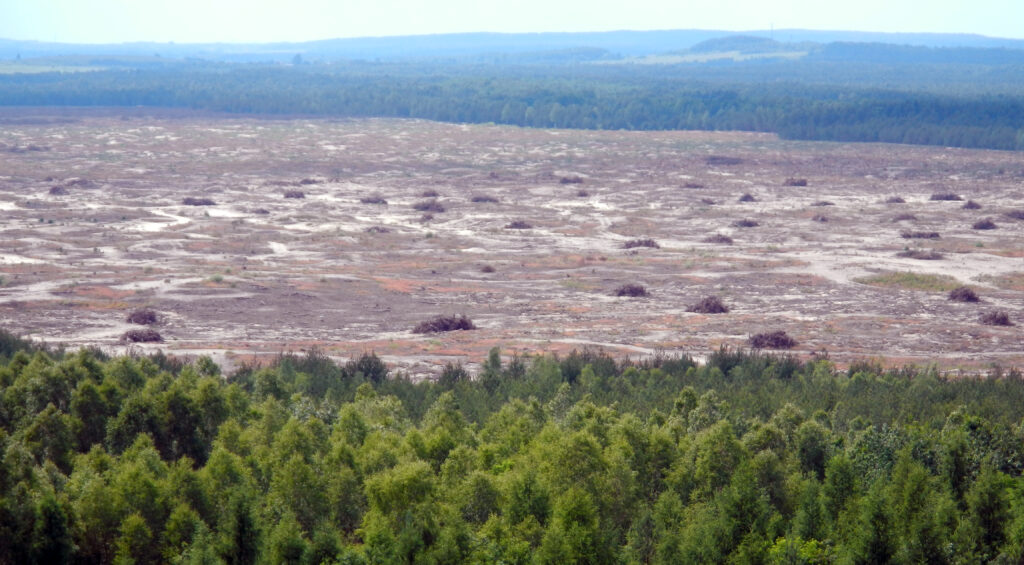
In the 20th century, the northern part of the desert became a military training ground used by airborne and other units for parachute jumps and manoeuvres. This zone is still closed to tourists but remains clearly visible from several viewpoints. At the same time, the gradual rise of groundwater, the end of grazing, and natural succession allowed grasses, shrubs, and young forest to colonize large parts of the sand.
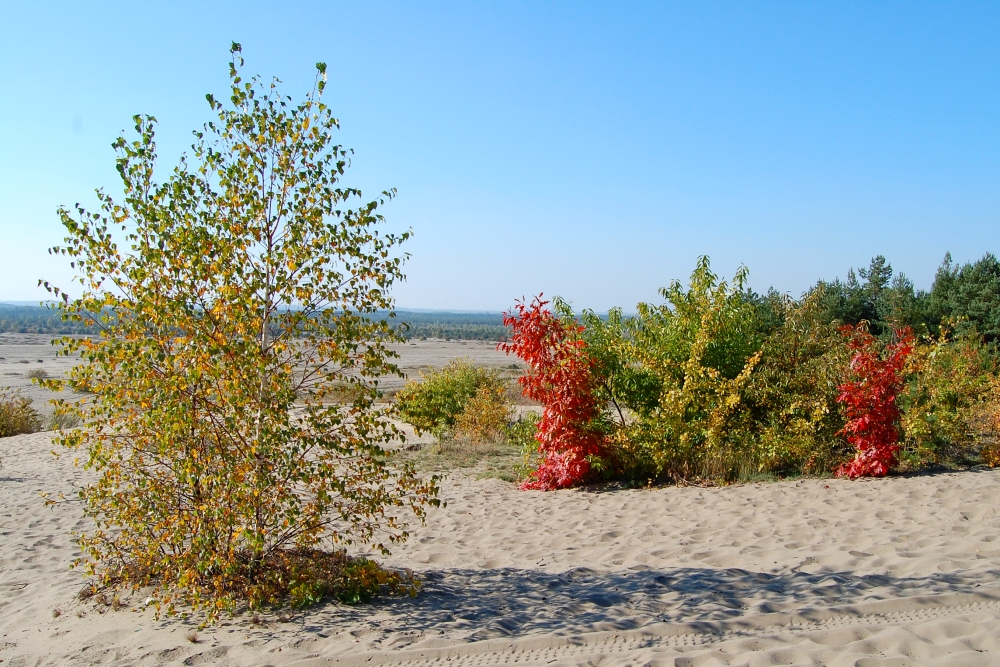
In recent years, conservation projects have aimed to preserve the “Polish Sahara” character in selected zones. In some areas, self-seeded trees are cut and vegetation is removed to maintain open sand as a unique geo-ecological landscape at the European scale.
What to See at Błędów Desert Poland – Main Attractions
Central sands and the Biała Przemsza River
The central part of Błędów Desert is a broad sandy basin where open dunes alternate with grassy patches and pioneer shrubs. The Biała Przemsza River flows east–west across the middle, splitting the desert into a southern recreational part and a more restricted northern military zone. From the viewpoints in Klucze and Chechło you clearly see the contrast between sand and surrounding forest, along with gentle ridges carrying viewing platforms.
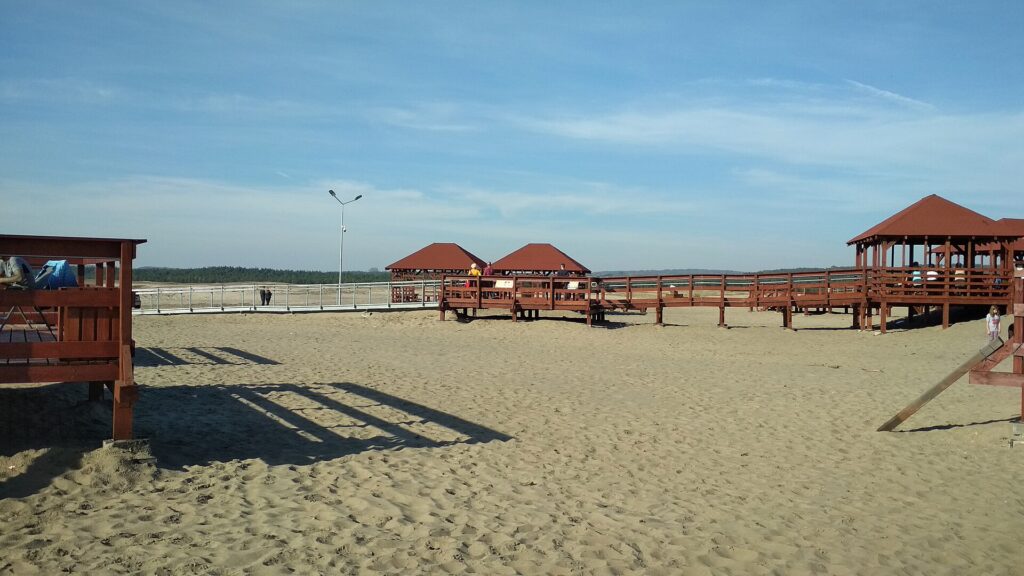
Walking on the sand: In the southern part you can walk on the sand in designated areas and along marked paths, taking care when crossing steeper dunes. For children: Running across the sand, climbing small dunes, and spotting animal tracks is great fun, but kids should be kept away from fenced military areas and warning signs.
⭐ Czubatka Viewpoint (Klucze)
Czubatka (about 382 m a.s.l.) is one of the classic and oldest viewpoints over Błędów Desert, located near the village of Klucze. From its summit you get the widest panorama of the “Polish Sahara” – a broad sand belt encircled by forest, with visible pathways and the distant strip of military ground. A large free car park, benches, picnic shelter, and educational boards make this an easy starting point for most visitors.
Access: From the parking lot it is only a gentle 5–10 minute walk along a wide path. Best time: Sunset, when the sand turns golden and dune shadows clearly reveal the relief. Insider tip: Use Czubatka as your first stop to understand the overall layout of the desert and decide which other viewpoints and trails to explore.
⭐ Rose of the Winds Platform (Róża Wiatrów, Klucze)
The Rose of the Winds is a modern wooden viewing complex in the Klucze area, designed as a multi-armed platform resembling a compass embedded in the sandscape. Long decks with railings allow safe observation of the desert, while detailed information boards explain geology, history, legends, and local wildlife. The approach has been built for easy access with strollers and for visitors with limited mobility.
Facilities: Hardened path, benches, viewpoint terrace over the central sands. Accessibility: Thanks to its asphalt or compact surface approach, the Rose of the Winds is one of the most wheelchair-friendly desert viewpoints in Poland. Insider tip: From this platform you can clearly see the difference between protected open-sand areas and zones heavily used by quads and off-road vehicles beyond the strictly protected core.
Dąbrówka Viewpoint (Chechło)
Dąbrówka hill near the village of Chechło (about 355 m a.s.l.) is the third major viewpoint overlooking Błędów Desert from the northwest. It features a metal viewing platform with a wide panorama over extensive open sands and a restored bunker integrated into the visitor area. From Dąbrówka you can step directly from the hill onto nearby sand patches, while still respecting barriers and avoiding military zones.
Getting there: Local roads connect Chechło with Olkusz and Dąbrowa Górnicza; there are informal parking areas and information boards at the hill. “Look From Above” route: Dąbrówka, Czubatka, and the Rose of the Winds are linked by hiking and cycling trails, allowing you to visit all three viewpoints in a single day.
Hiking trails, cycling routes, and military zones
Several marked hiking and cycling routes weave around Błędów Desert, including a scenic loop connecting the three main viewpoints. Trails run both along the desert’s sandy edge and through forest enclaves in the surrounding Błędowskie Woods. Because of the active military training ground, much of the northern desert is strictly off-limits – visitors must obey warning signs and never cross fences or barriers.
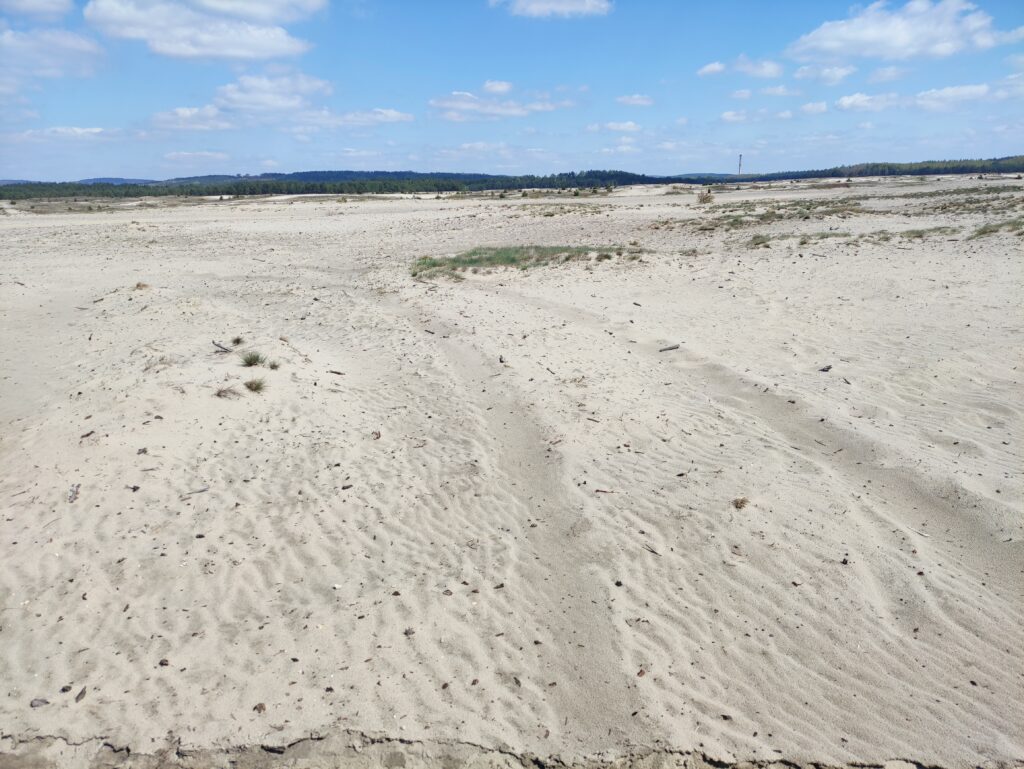
Safety: The open tourist area is safe for walking, though sand can become very hot on sunny days and climbing dunes is physically demanding. Carry water, wear sturdy footwear, and protect yourself from the sun. Always keep a respectful distance from clearly marked military zones.
How to Reach Błędów Desert Poland
Location between Kraków and Katowice
Błędów Desert lies on the border between the Silesian and Lesser Poland (Małopolska) regions, between Olkusz, Dąbrowa Górnicza (Błędów district), and the villages of Klucze and Chechło. Travel time from both Kraków and Katowice is usually about 1 hour by car, following a mix of main and local roads crossing the Kraków-Częstochowa Upland.
Driving from Kraków
From Kraków, the simplest route goes toward Olkusz (for example via national road 94) and then north to Klucze or Chechło, depending on chosen viewpoint. The distance to Czubatka and the Rose of the Winds is roughly 50–60 km, normally about 1 hour of driving. Roads are asphalt almost the entire way; the viewpoints have free parking nearby.
Suggested combo: Combine Błędów Desert with Ojców National Park, Rabsztyn Castle, or other Kraków-Częstochowa Upland sights to create a full-day scenic loop.
Driving from Katowice
From Katowice, drive toward Dąbrowa Górnicza and then continue toward Błędów and Klucze. Distance is again roughly 50–60 km with around 1 hour driving time. Access to Chechło (Dąbrówka viewpoint) is similarly straightforward via local roads, though some final sections can be narrow.
Public transport options
Reaching Błędów Desert by public transport is possible but involves regional buses plus walking. A typical route is to travel by bus or train from Kraków or Katowice to Olkusz or Dąbrowa Górnicza, then transfer to a local bus or minibus toward Klucze or Chechło, and finally walk to your chosen viewpoint. Total travel time may exceed 2 hours each way, and timetables change seasonally.
Reality check: Due to infrequent departures and multiple transfers, public transport is most practical for determined budget travellers or locals. For most visitors, driving a car or joining an organized tour is far more convenient.
Best Time to Visit Błędów Desert Poland
Time of day – light and temperature
The best times of day are early morning (around 08:00–11:00) and late afternoon to sunset (from about 16:00 onwards in summer). Low sun stretches dune shadows and adds depth and texture to the sand, while temperatures remain more comfortable. Midday light is harsh, and the sand becomes very hot in summer, making walking and photography less pleasant.
Sunset on Czubatka: This is especially impressive – glowing orange-red skies above the “Polish Sahara” and long shadows create highly photogenic scenes. Bring an extra layer for after sunset, as the air cools quickly on the exposed hilltops.
Seasons
Spring (April–May): Air is pleasantly cool, sand has not yet heated up, and fresh green forest around the desert provides excellent colour contrast. Tourist numbers are moderate.
Summer (June–August): Best chance for clear skies and spectacular sunsets, but also the hottest period. Sand can become extremely hot, so avoid long walks at midday. Weekends see more visitors at the main viewpoints.
Autumn (September–October): Softer light, cooler temperatures, and golden foliage in surrounding forests make this a wonderful time for photography and hiking. Crowds are smaller than in summer.
Winter (November–March): Snow and frost partially cover the sand, turning the desert into a pale beige-white plain. The landscape becomes harsher but visually striking. Expect cold wind and potentially icy access roads; dress warmly and check conditions before traveling.
Activities and Experiences at Błędów Desert Poland
Walking and photography
The simplest way to experience the desert is a relaxed walk on the viewing platforms and along selected sand sections. Photographers enjoy wide-angle shots from Czubatka, Rose of the Winds, and Dąbrówka, showing the sand “island” framed by forests, as well as close-ups of ripples, pioneer plants, and tracks in the sand.
Photo tip: Use a wide-angle lens for panoramas and a telephoto to crop out distracting trees or buildings. Early morning and late afternoon give the strongest contrast between light and shadow on dunes.
Hiking and cycling
Marked hiking trails and a cycling route connect the three main viewpoints. Trails are generally easy, though cycling on loose sand can be demanding; much of the cycling route uses firmer forest roads. The complete “Look From Above” loop can comfortably fill a full day of recreational hiking or mountain biking.
Watching military training and events
On certain days, especially weekends, the military training ground hosts parachute drops and exercises that can be viewed safely from public viewpoints. Occasionally, the area also hosts historical reenactments, desert running events, nordic-walking rallies, or obstacle races that use parts of the sandy terrain.
Tip: To catch such events, monitor websites and social media of the Klucze and Dąbrowa Górnicza municipalities or local tourist boards; programming changes from year to year.
Combining Błędów Desert Poland with Nearby Attractions
Kraków-Częstochowa Upland and Eagles’ Nests Trail
Błędów Desert sits on the edge of the Kraków-Częstochowa Upland, making it easy to combine with castles and cliffs along the Eagles’ Nests Trail. Nearby you will find Rabsztyn Castle, smaller Siedlec “desert”, limestone valleys, and numerous climbing and cycling routes. Many travellers plan a morning at Błędów Desert followed by an afternoon castle visit or hike in a landscape park.
Kraków and Katowice as bases
Because of its position between two large cities, many visitors treat Błędów Desert as a half-day escape from Kraków or Katowice. This creates an appealing contrast: historic urban sightseeing in the morning, then a surprising desert landscape in the afternoon. For short stays in the region, it is one of the easiest “unusual” nature trips achievable without long drives.
Practical Tips – Safety, Gear, Accessibility
What to bring
- Water and snacks: There is no permanent food service directly on the desert; bring drinks and snacks, especially in hot weather.
- Sun protection: Hat, sunscreen, and sunglasses are essential – sand reflects sunlight and increases UV exposure.
- Footwear: Trainers or light hiking shoes with good grip; in summer sandals can work, but the sand may be very hot by midday.
- Layered clothing: Even in summer it can feel cool and windy on hilltops after sunset.
- Camera or smartphone: Fully charged with plenty of storage – the landscape is unlike most of Poland and you will likely shoot a lot.
Safety and rules
The desert is generally safe, but basic precautions apply. Never enter zones marked as military area or ignore warning signs. In hot weather, avoid overexertion and watch for overheating – there is little shade. During longer dry spells, small-scale dust storms can occur, briefly kicking up sand; protect your eyes and equipment if strong gusts start.
Stay on marked paths whenever possible to protect fragile pioneer vegetation and avoid disturbing wildlife. Despite its barren appearance, the desert supports specialized insects, birds, and plants adapted to dry, sandy conditions.
Accessibility
Thanks to recent infrastructure investments, Błędów Desert is more accessible than ever for visitors with limited mobility. The Rose of the Winds viewpoint in particular offers a hardened approach path, gentle gradients, and wheelchair-friendly platforms. Czubatka and Dąbrówka involve slightly steeper or sandier paths, better suited to reasonably fit visitors or those with assistance.
Wheelchair users and families with strollers should choose dry days to avoid mud and focus on the main prepared paths instead of informal shortcuts. Checking the latest local information on trail conditions and access is advisable before planning a visit.