Quick answer
Poland is one of the EU’s fastest catch-up stories. In 2025 its GDP per person, adjusted for prices, reached 81% of the EU average, up from 44% in 1995, and household consumption reached 88%. Prices are still low: Poland was the third cheapest country in the EU at 73% of the average price level. Unemployment is among the lowest in Europe at 3.4% (July 2026), while inflation (4.1% in September 2026) and electricity costs relative to income remain weak spots. The population is shrinking: about 37.2 million in mid-2026.
How does Poland compare with the rest of Europe? This page of Poland in numbers collects the key figures in one place, each with its source, so you can see where Poland stands on income, prices, jobs, energy and population. We update it as new data comes out.
Poland at a glance
| Indicator | Poland | Comparison | Period |
|---|---|---|---|
| GDP per capita in purchasing power | 81% of EU average | Czechia 92%, Portugal 81%, Romania 78% | 2025 |
| Household consumption per capita in purchasing power | 88% of EU average | Up from 85% in 2024 | 2025 |
| Price level of household consumption | 73% of EU average | Only Bulgaria (63%) and Romania (65%) cheaper | 2025 |
| Unemployment rate | 3.4% | EU average 6.1%; Czechia lowest at 3.3% | July 2026 |
| Consumer price inflation | 4.1% | 3.4% in August 2026 | September 2026 |
| Household electricity price in purchasing power | 37.15 PPS per 100 kWh, 3rd highest in the EU | After Romania and Czechia | Second half of 2025 |
| Population, official | about 37.24 million | 90,000 fewer than at the end of 2025 | First half of 2026 |
| Life expectancy at birth | Men 74.9 years, women 82.3 years | Highest ever recorded in Poland | 2024 |
Income: how close is Poland to the EU average?
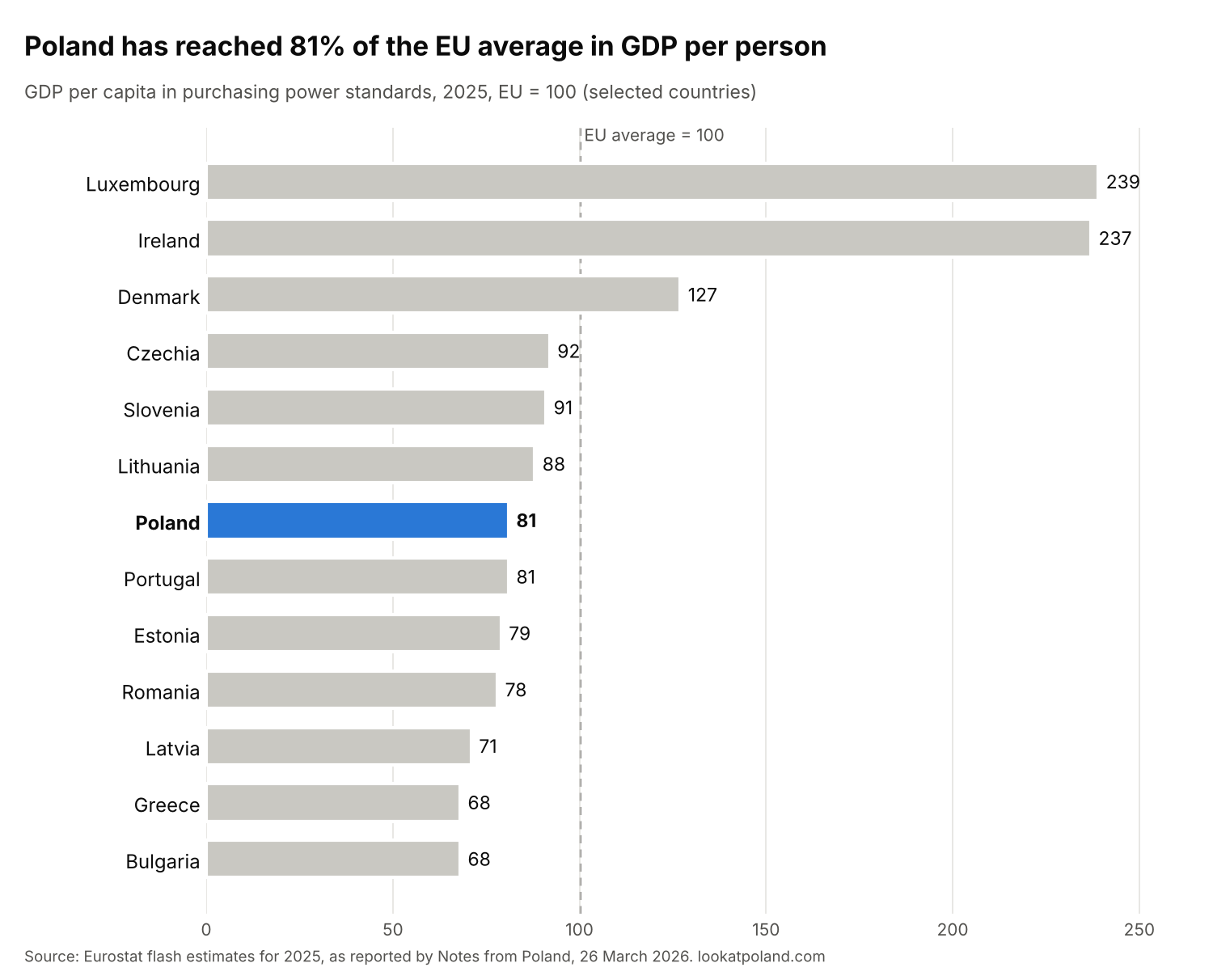
Gross domestic product per person, adjusted for differences in prices between countries, is the most common way to compare living standards. In 2025 Poland reached 81% of the EU average, its highest figure ever and level with Portugal. In 1995 it was 44%: a gain of 37 percentage points in three decades.
GDP includes things that do not end up in people’s pockets, such as company profits sent abroad. A measure closer to everyday life is actual individual consumption: what households actually consume per person, including public services such as healthcare and education. On this measure Poland reached 88% of the EU average in 2025, up from 85% a year earlier, overtaking Portugal, Romania, Slovenia and Lithuania and drawing level with Malta.
Prices: still one of the cheapest countries in the EU
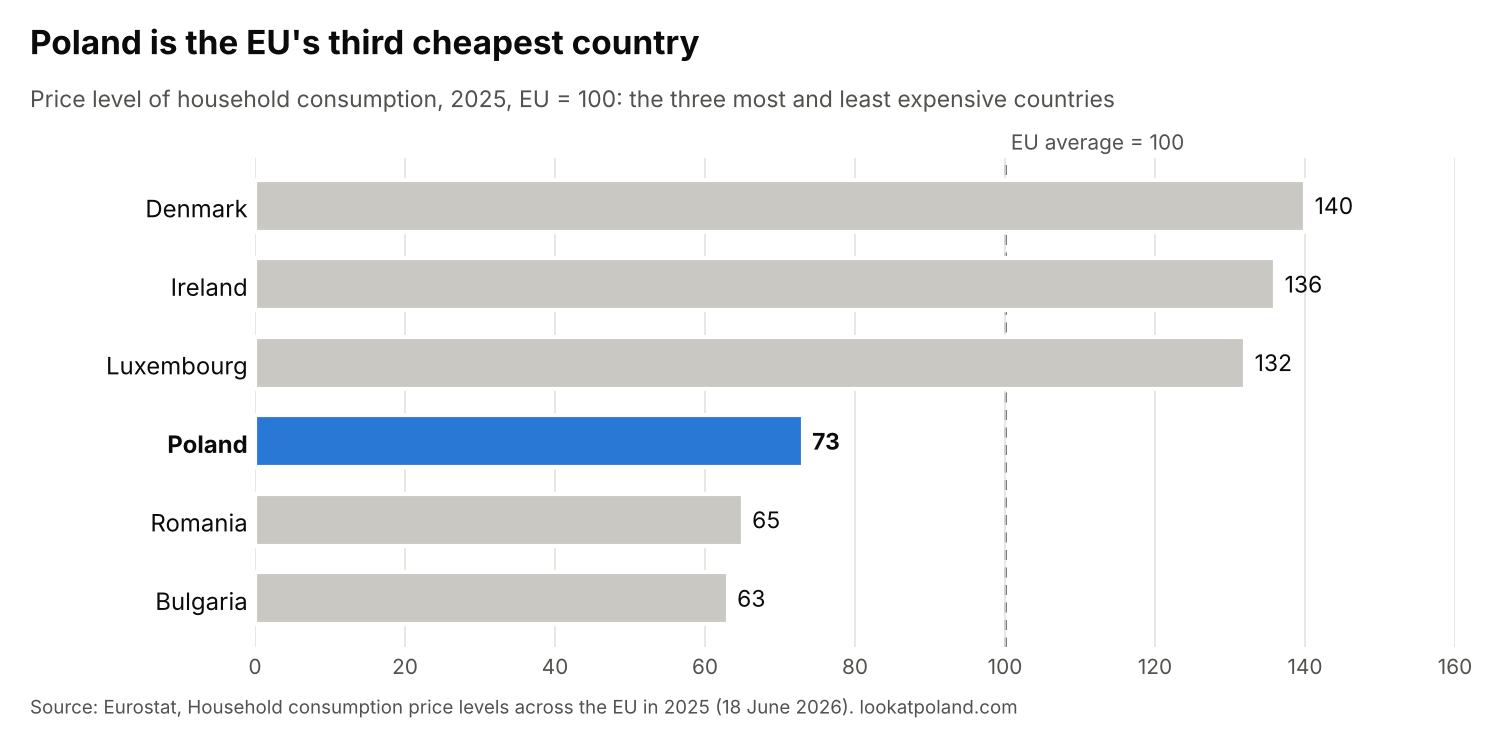
The same basket of goods and services that costs 100 on average across the EU cost 73 in Poland in 2025. Only Bulgaria and Romania were cheaper; Denmark, Ireland and Luxembourg were the most expensive. Within food, Eurostat found Poland the cheapest country in the EU for “other food products”, which include sugar, jam and sweets.
Low prices plus rising incomes explain why consumption has caught up faster than GDP. For what this means in złoty, from rent to a monthly bus pass, see our guide to the cost of living in Poland.
Jobs: one of the lowest unemployment rates in Europe
Poland’s unemployment rate, measured the same way across the EU, was 3.4% in July 2026, the second lowest in the Union after Czechia (3.3%) and well below the EU average of 6.1%. Poland has also become a destination for workers from abroad: an experimental Statistics Poland count estimated about 2.3 million foreigners living in Poland at the end of 2025.
Wages have risen quickly but remain below Western levels. The minimum wage in 2026 is 4,806 zł gross a month, and the average wage in the enterprise sector was about 9,500 zł gross in July 2026. Across the EU, monthly minimum wages range from €620 in Bulgaria to €2,704 in Luxembourg.
Inflation and energy: the weak spots
Consumer prices in Poland rose 4.1% in the year to September 2026, up from 3.4% in August and above the central bank’s target range. Transport, mostly fuel, was up 17.9% on a year earlier, and services 5.3%, while food was 0.4% cheaper.
Electricity tells a similar story of two measures. Converted into euros, Polish household electricity is not among the three most expensive in the EU, but measured against what people can afford, it is: in purchasing power terms Poland ranked third highest in the second half of 2025, after Romania and Czechia. The government cap on household electricity prices expired at the end of 2025.
Population: shrinking, ageing and more diverse
Officially, Poland had about 37.24 million inhabitants in the first half of 2026, around 90,000 fewer than at the end of 2025. Statistics Poland’s experimental estimate of the people actually present in the country, based on administrative data, was higher at about 38.8 million at the end of 2025, including some 2.3 million foreigners. The two numbers measure different things and should not be compared directly.
People are living longer: in 2024 life expectancy at birth reached 74.9 years for men and 82.3 years for women, the highest ever recorded in Poland.
How to read these numbers
- Purchasing power standards (PPS) are an artificial currency used by Eurostat to remove price differences between countries. 100 PPS buys the same amount of goods and services everywhere in the EU.
- Flash estimates are early figures and can be revised when final data comes in.
- Averages hide regional differences. Warsaw is far richer than the national average, and eastern regions are poorer.
Last checked: 16 October 2026. We update this page when new Eurostat and Statistics Poland data is published.
Sources
- Notes from Poland: GDP per capita in PPS, 2025 (Eurostat data)
- Notes from Poland: actual individual consumption per capita, 2025 (Eurostat data)
- Eurostat: household consumption price levels across the EU in 2025
- Eurostat: comparative price levels for food, beverages and tobacco
- Polskie Radio: Polish jobless rate second lowest in the EU in July 2026 (Eurostat data)
- Super Biznes: GUS inflation data for September 2026 (in Polish)
- Podatki.biz: GUS inflation data for August 2026 (in Polish)
- Eurostat: household electricity prices in the second half of 2025
- Bankier.pl: GUS population figures and experimental estimate (in Polish)
- bne IntelliNews: record life expectancy in Poland, 2024
- Euronews: minimum wages across Europe in 2026 (Eurostat data)
- Money.pl: GUS wage data for July 2026 (in Polish)